September 12–18, 2026
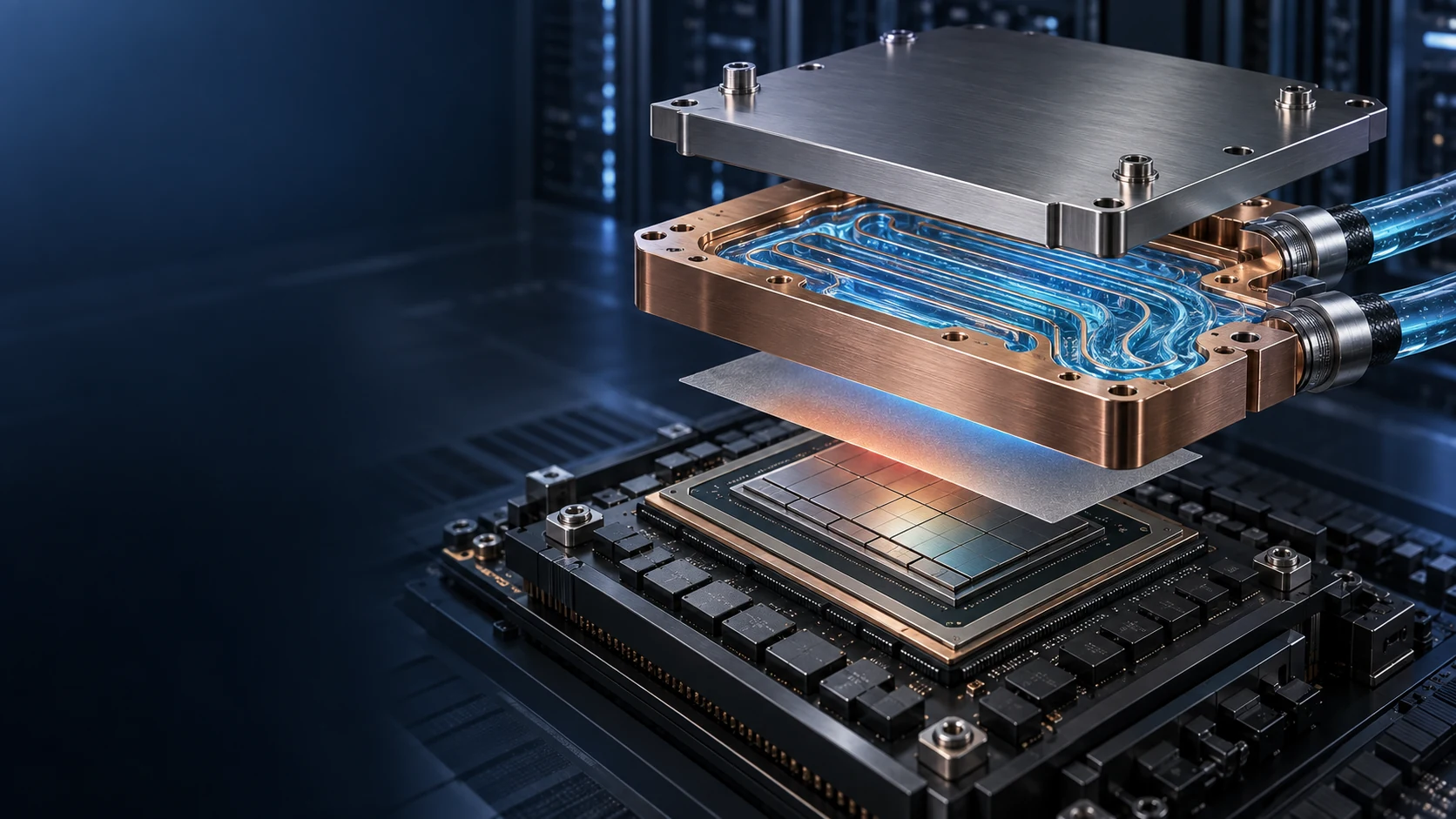
As AI servers continue to move toward higher chip power, advanced packaging and direct-to-chip liquid cooling, thermal performance can no longer be evaluated by thermal conductivity alone.
This week, JunPus reviewed new technical and industry materials covering three important areas:
1. PFAS transparency and cooling-material supply chains
2. Cold-plate and coolant co-design for high heat flux
3. Transient thermal loads and reliability validation
The external data summarized below does not represent JunPus product performance or customer qualification results. It is provided as an engineering reference for application-specific evaluation.
1. PFAS Transparency Is Becoming an AI Cooling Procurement Consideration
A report published by ChemSec on September 13, 2026, states that many of the world’s largest PFAS producers are expanding production capacity, partly in response to demand from AI and data-center infrastructure, semiconductor manufacturing and lithium-ion batteries.
The report is based on public company documents, regulatory information and EU and US substance data. It does not provide a complete global production database and should not be interpreted as a universal regulatory ban on PFAS.
Source: ChemSec – The World’s Top 10 PFAS Producers
Engineering relevance
For thermal materials and liquid cooling systems, customers are increasingly likely to request:
- Raw-material declarations and CAS-number traceability
- PFAS-related substance screening
- Chemical compatibility information
- Long-term material stability data
- Documentation for regional regulatory review
JunPus perspective
For LiquidTherm Coolant and JunPus thermal interface materials, the immediate priority is not to make an unsupported “PFAS-free” claim. The priority should be to establish a controlled material-disclosure package covering raw materials, additives, fluorinated substances, total fluorine screening where appropriate and supplier traceability.
2. Cold-Plate Performance Depends on Co-Design
A new study from Shanghai Jiao Tong University examined liquid-cooling channel optimization for high-heat-flux cold plates. The work was submitted to arXiv on September 11, 2026 and has an accepted Energy manuscript associated with the study.
The model evaluated copper cold plates using water at approximately 35°C. The reported conditions included:
- Laminar heat flux: approximately 10 W/cm²
- Turbulent heat flux: approximately 100 W/cm²
- Channel velocity range: approximately 0.03–3.5 m/s
- Prototype minimum channel size: approximately 0.47 mm
- Manufacturing tolerance: approximately ±0.02 mm
The study reported simulated reductions in temperature rise and pressure drop compared with a reference channel layout. However, the systematic prototype thermal validation remains limited, and the paper did not model actual TIM bond-line thickness, clamping pressure, package warpage or pump-out behavior.
Sources: arXiv preprint|Energy DOI
Engineering relevance
Cold-plate performance is determined by the combined behavior of:
- Coolant temperature and flow rate
- Channel geometry and manufacturing tolerance
- Pressure drop and pump power
- TIM bond-line thickness
- Contact pressure
- Package and cold-plate flatness
- Long-term reliability
A high thermal-conductivity TIM does not automatically produce the lowest package-level thermal resistance.
JunPus perspective
JunPus should position JP-DX1, JP-DX2 and JP-DXSquare Elite using application-level data:
- Rth versus BLT
- Rth versus contact pressure
- Temperature rise across the TIM
- Performance on copper, nickel-plated copper and aluminum surfaces
- Thermal cycling and power-cycling stability
- Pump-out, bleed-out and coverage retention
LiquidTherm Coolant should be evaluated together with a defined cold-plate geometry rather than as a standalone property sheet.
3. Transient Thermal Loads Require Additional Reliability Testing
A new preprint titled HeatCache studied thermal-aware scheduling for liquid-cooled edge servers. The research used four water-cooled RTX 4090 systems with approximately 600 mL of coolant per loop.
The test environment included:
- Ambient temperature range: approximately 18–48°C
- Water-cooled GPU testbed
- Multiple large-language-model workloads
- Pump and fan power included in system evaluation
The authors reported reductions in computing energy, GPU throttling exposure and service-level-objective violations. These results came from a combination of workload scheduling, DVFS control, thermal storage and AIO cooling. They should not be interpreted as performance data for a specific TIM or coolant.
Source: HeatCache preprint
Engineering relevance
AI workloads create repeated thermal transitions rather than only steady-state heat loads. Qualification should therefore include:
- Step-load response
- Burst workloads
- Power cycling
- Thermal recovery time
- Rth drift after repeated transients
- Pump-out and bleed-out after cycling
- Coolant chemistry and particle monitoring
JunPus perspective
JP-DXSquare Elite should be prioritized for high-heat-flux transient testing. JP6080 should be evaluated for shape retention and flow behavior in multi-height applications. LiquidTherm should be tested for temperature-dependent viscosity, pressure drop, corrosion, particle generation and seal compatibility.
Implications for JunPus Products
| Product |
Recommended focus |
| JP-DX1 |
Establish a reliable baseline using Rth–BLT–pressure data |
| JP-DX2 |
Demonstrate thin-BLT and lower interface temperature rise rather than relying only on thermal conductivity |
| JP-DXSquare Elite |
Prioritize high-heat-flux cold-plate and power-cycling validation |
| JP6080 |
Validate multi-height gap filling, dispensing repeatability, flow resistance and shape retention |
| LiquidTherm Coolant |
Build temperature-dependent flow, pressure-drop, corrosion, particle and material-compatibility data |
Recommended Validation Priorities
1. Material disclosure and chemical screening
Establish supplier traceability, CAS documentation and PFAS-related screening before making environmental claims.
2. Cold-plate reference loop
Test LiquidTherm and reference water at 25°C, 30°C and 35°C using a defined copper or nickel-plated cold plate. Measure flow rate, pressure drop, thermal resistance, corrosion, particles, pH, conductivity and viscosity.
3. Transient and reliability testing
Test JP-DX1, JP-DX2 and JP-DXSquare Elite under step loads and power cycling. Track temperature rise, recovery time, Rth, BLT, coverage, pump-out and bleed-out.
Important Note
The materials reviewed this week are research papers, preprints, company reports and industry analyses. They are not JunPus product qualification results and do not represent new JEDEC, IPC, OCP, IEC or ISO certification requirements.
JunPus recommends evaluating thermal interface materials and coolants under defined assembly conditions, including heat flux, BLT, clamping pressure, cold-plate material, coolant temperature, flow rate and reliability duration.
For application-specific TIM and liquid-cooling evaluation, contact JunPus Thermal Solutions.
Sources